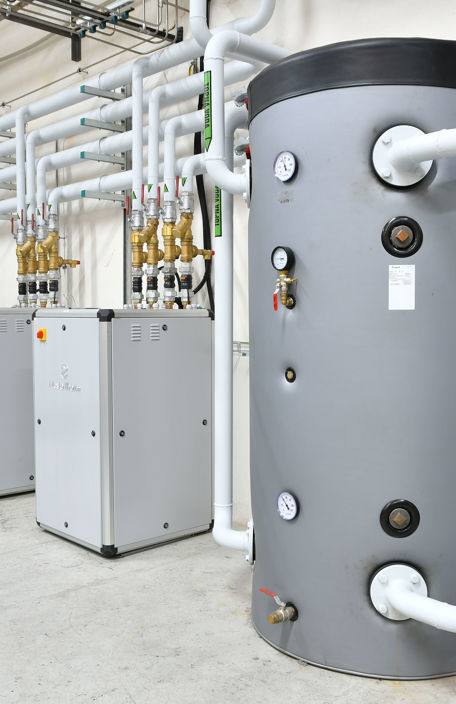
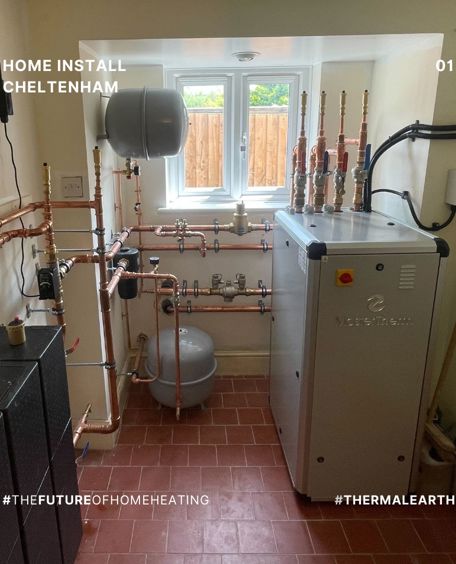
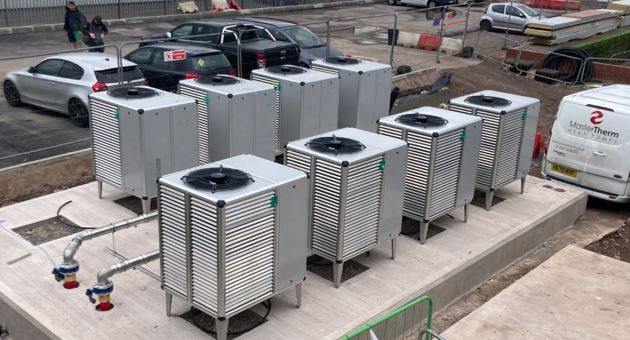
How to heat efficiently, economically, and without compromise? The solution lies in heat pumps operating in a bivalent (hybrid) system, combining maximum use of renewable energy sources with the reliability of backup heating capacity.
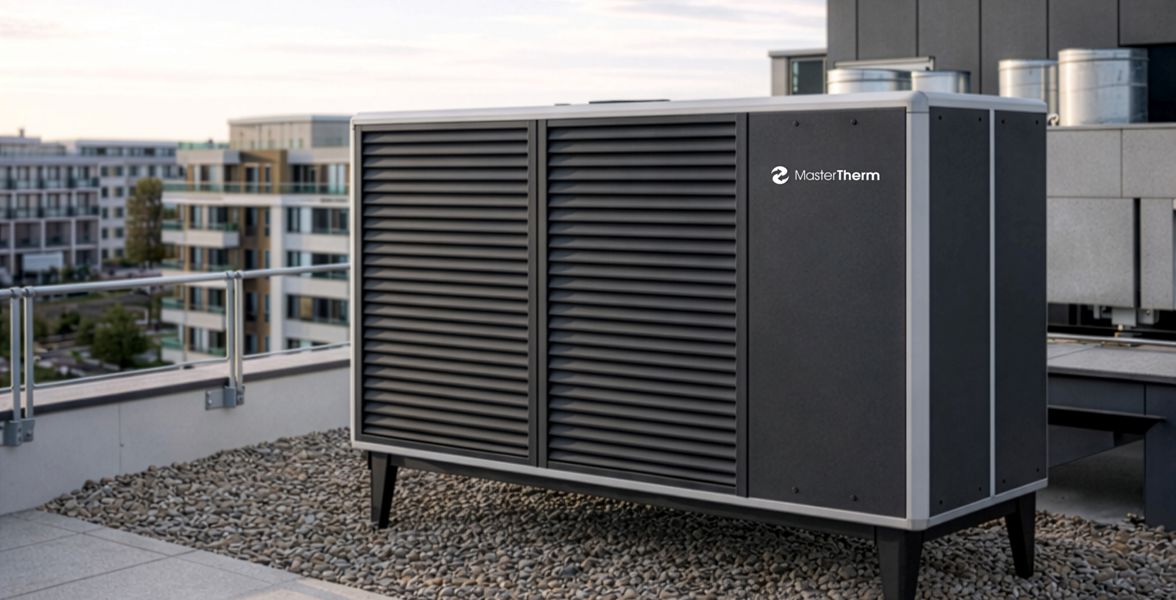
Heat pumps have become an integral part of modern heating systems. However, the key question remains how to integrate them optimally into both new and existing buildings. The greatest challenge is typically found in larger office and residential complexes.
In practice, the most effective long-term solution has proven to be the combination of cascaded heat pump systems with a bivalent (hybrid) setup. This is not a temporary trend, but a proven approach that performs reliably across a wide range of real operating conditions.
The following overview explains the basic principles of proper design and operation.
1. Standard heat pump operation (above the bivalent point)
At outdoor temperatures above the bivalent point, the heat pump fully covers the building’s heating demand. The backup heat source (e.g. a gas boiler) remains inactive.
The system operates in modulation mode — either as a cascade of multiple units or as a single inverter-driven unit. Output is continuously adjusted to match the current demand, providing:
- precise coverage of the heating load
- high efficiency, especially at partial load
- reduced compressor cycling and longer system lifespan
The control system ensures:
- sequential switching of units in the cascade
- smooth output regulation
- stable supply temperatures through weather-compensated control
The result is stable and energy-efficient operation without unnecessary switching on and off.
2. Approaching the bivalent point
As outdoor temperatures decrease, heating demand increases and the system gradually approaches its performance limits.
Modern hybrid systems do not switch immediately to the backup heat source. Instead, they use a controlled transition based on two conditions:
- failure to reach the required temperature
- persistence of this condition for a defined period of time
This approach ensures that:
- short-term fluctuations do not activate the boiler
- the system remains stable during defrost cycles or peak loads
- the heat pump has sufficient time to stabilize independently
The use of hysteresis further reduces unwanted switching of the backup source.
As a result, the backup source is activated only when truly necessary, while the system always prioritizes heat pump operation.
3. Active bivalent operation
When outdoor temperatures drop below the bivalent point, the system transitions into hybrid mode.
The heat pump remains the primary heat source, while the boiler supplies only the missing capacity.
Unlike conventional systems:
- the system does not switch completely to boiler operation
- heating output is continuously shared between both sources
The boiler operates modulatingly and responds to the system’s current demand. At the same time, the heat pump continues operating at its maximum efficient output.
The result is:
- maximum utilization of renewable energy
- reduced fossil fuel consumption
- stable operation without overheating
- optimized seasonal performance (SCOP)
In properly designed systems, the heat pump can cover up to 70–90% of the annual heating demand.
Hybrid heating systems controlled by heat pumps represent an efficient and flexible solution for modern heating applications.
4. Operation at low outdoor temperatures
Modern hybrid systems typically do not shut down the heat pump even at very low temperatures. Instead, the heat pump continues operating together with the backup source.
Complete shutdown of the heat pump occurs only based on economic criteria, for example in cases of:
- high electricity prices
- low current efficiency (COP)
The system continuously compares the cost of heat production from individual sources and optimizes operation according to current conditions.
This approach allows the system to:
- minimize operating costs
- maintain system flexibility
- respond dynamically to energy price developments
5. Domestic hot water (DHW) preparation
Domestic hot water preparation is the most demanding part of operation in terms of efficiency because it requires higher temperatures.
To optimize operation, the following is recommended:
- standard water heating to 45–50 °C
- regular reheating to ≥60 °C for legionella protection
The frequency of thermal disinfection depends on the type of building (e.g. once per week in standard buildings).
Advantages of this approach include:
- higher seasonal efficiency
- lower energy consumption
- compliance with hygiene requirements
For high-temperature reheating, the backup source or an electric heating element may be used. It is also recommended to separate domestic hot water preparation from the heating circuit.
Heat pumps with a bivalent heat source provide high efficiency, long-term stable operation, and meet the key requirements expected from a modern heat source:
- maximum use of renewable energy
- reduced CO₂ emissions
- reliable operation even under extreme conditions
With the kind permission of MasterTherm Ireland / Lukáš Kadlík – MasterTherm Ireland